Tanzania Coffee: Market, Origins & Sourcing Guide
Overview
Coffee is Tanzania’s most important export crop and one of its oldest cash crops, introduced under German colonial administration in the early twentieth century and expanded significantly under subsequent British rule. Today the crop is grown across several distinct highland zones, split between Arabica and Robusta varieties, and marketed through a regulatory structure overseen by the Tanzania Coffee Board (TCB), a government body established under the Tanzania Coffee Industry Act No. 23 of 2001. Production remains overwhelmingly smallholder-driven: more than 320,000 smallholder households farm an average of 0.5–1.0 hectares each, producing the large majority of the national crop, with a small number of larger estates accounting for the remainder.
Production & Growing Regions
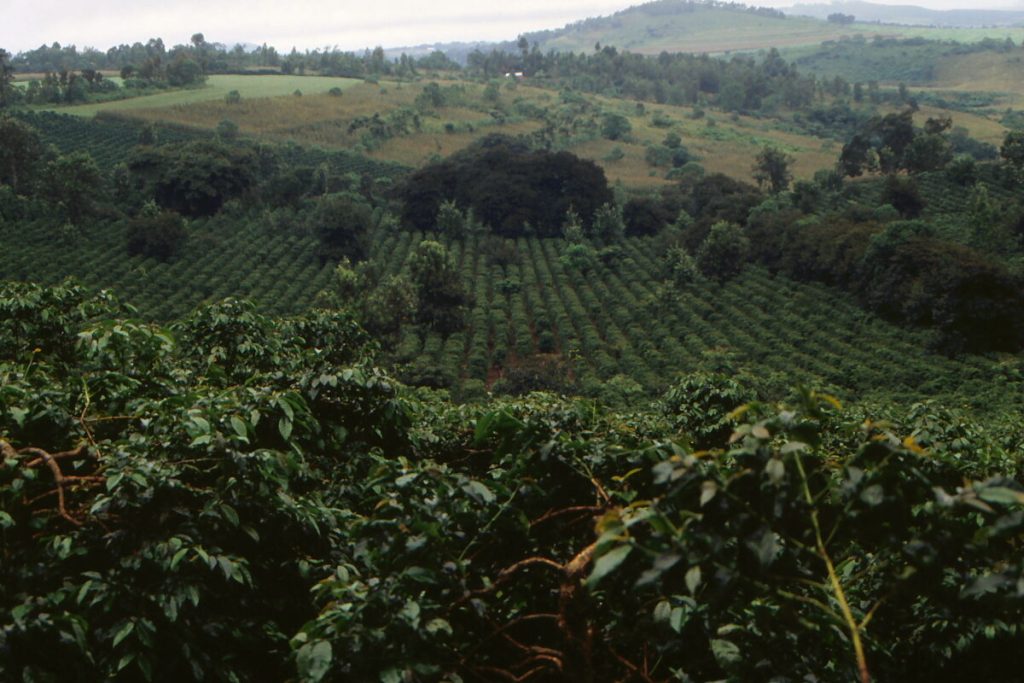
Tanzanian coffee is grown in three broad zones. In the north, Arabica is cultivated on the volcanic slopes of Mount Kilimanjaro and Mount Meru, spanning Kilimanjaro, Arusha and Tanga (Usambara Mountains) regions. In the Southern Highlands — now recognized by most trade sources as the larger Arabica source — coffee is grown across Mbeya, Songwe and Ruvuma regions, including well-known coffee districts such as Mbinga, Songea, Rungwe and Mbozi. Robusta is concentrated in the northwest, in Kagera region near Lake Victoria (notably the Bukoba, Muleba, Kyerwa and Karagwe districts), with additional Robusta and mixed production reported in Kigoma, Morogoro and Mwanza.
Sources differ on the precise national Arabica/Robusta split — figures ranging from roughly 60% Arabica/40% Robusta to about 70%/30% appear across recent trade reporting, likely reflecting different reporting years and methodologies. What is consistent is that Arabica dominates in volume and that a majority of it now originates from the Southern Highlands rather than the historically better-known Kilimanjaro area.
National output has fluctuated with weather and input costs, falling to roughly 1.15 million 60kg bags in 2022/23 amid drought and high fertilizer prices, then rebounding to around 1.35–1.4 million bags in 2023/24 and approximately 1.5 million bags in 2024/25 as rehabilitated farms matured. A 2026 industry export review projects continued growth toward roughly 1.6 million bags for the 2026/27 crop. The Tanzania Coffee Board’s seedling-distribution program — 13 million improved seedlings distributed by November 2023, targeting 25 million by end-2025 — is cited as a driver of this recovery.
Processing
The dominant processing method for Tanzanian Arabica is fully washed: cherries are depulped, fermented to remove mucilage and sun-dried, either by farmers using hand pulpers or, more commonly, at central pulping units operated by cooperatives. An estimated 90% of Tanzanian Arabica is processed this way, with the balance dry-processed (“natural”). Robusta is typically natural-processed, though limited experimental washed-Robusta and honey-processed Arabica lots have appeared in recent years as producers target specialty buyers.
Grading System
Tanzania uses a British-derived nomenclature based on bean size, shape and density. Beans are sorted into grades including AAA/AA, A, B, PB (peaberry), C, E, F, AF, TT, UG and TEX, with AA and PB generally commanding premium interest — the peaberry grade in particular is prized by Japanese and US roasters. Washed (“mild”) Arabica carries an additional cup-quality classification layered on top of the size grade, while Robusta is graded primarily by screen size (for example, Screen 18 “Extra” and Screen 16 “Superior”).
Marketing Structure
Coffee marketing is regulated by the TCB. The centerpiece is the Moshi Coffee Exchange, which holds a weekly (Thursday) auction during the trading season; licensed exporters without an exemption must buy through this or one of several other approved regional auction sites, including Songwe and Mbinga. Registered growers and exporters may also arrange direct export contracts outside the auction, subject to TCB registration, and an informal farmgate market exists where farmers sell cherry or parchment to private buyers and cooperatives.
Quality Characteristics
Cup character varies meaningfully by region. Northern coffees — grown in Kilimanjaro’s volcanic soils — tend toward pleasant aromatics, rich acidity and sweet balance, while Southern Highlands coffees lean toward a medium body with fine acidity and fruity, floral notes. Across origins, Tanzanian Peaberry is noted for its full body and vibrant, mellow character, a distinguishing feature in specialty circles.
Trade & Export Context
The large majority of Tanzanian coffee is exported: 2023/24 exports were roughly 1.27 million 60kg bags, rising to about 1.31 million bags in 2024/25, with the European Union the leading destination (an estimated 752,000 bags, around 59% of 2023/24 exports). Japan remains a historically significant and high-value buyer — long marketing Tanzanian coffee under the “Kilimanjaro” name regardless of actual growing region — alongside a growing United States market; smaller volumes move to Morocco, Russia, South Korea, India, Australia and South Africa. Tanzania’s share of global coffee supply is roughly 0.7%, underscoring that its trade significance rests on quality and origin story rather than scale.
Current Market
| Market | Type | Grade | Price | Observed | Source |
|---|---|---|---|---|---|
| ICO group indicator — Other Mild Arabicas | International | Other Mild Arabicas (not Tanzania-specific) | USD 7.37/kg | 1 Mar 2026 | International Coffee Organization (via IndexMundi) |
| Kagera Region auctions | Auction | Cherry, unspecified | TZS 5,310.00/kg | 9 Jul 2026 | Tanzania Coffee Board (via Food Business MEA) |
| Kagera Region auctions | Auction | Clean coffee, unspecified | TZS 10,005.00/kg | 16 Jul 2026 | Tanzania Coffee Board (via Food Business MEA) |
| Ngara Farmers' AMCOS cooperative (Kagera) | Farm gate | Certified Arabica, average | TZS 5,505.00/kg | 9 Jul 2026 | Tanzania Coffee Board (via Food Business MEA) |
| Rwele AMCOS cooperative (Kagera) | Farm gate | Robusta, unspecified | TZS 4,600.00/kg | 9 Jul 2026 | Tanzania Coffee Board (via Food Business MEA) |
- Tanzania Coffee Board — TCB — Home — https://www.coffee.go.tz/index.php — 2026-09-24
- Daily Coffee News — Tanzania Coffee Report: Production Rising as Old Farms Get New Life — https://dailycoffeenews.com/2024/07/01/tanzania-coffee-report-production-rising-as-old-farms-get-new-life/ — 2026-09-24
- Comunicaffe — USDA sees Tanzania's coffee production up 21% in market year 2023/24 — https://www.comunicaffe.com/tanzania-coffee-production-to-surge-21-in-my2023-24/ — 2026-09-24
- Royal Coffee — Tanzania Export Review — https://royalcoffee.com/tanzania-export-review/ — 2026-09-24
- Perfect Daily Grind — A guide to Tanzanian coffee production — https://perfectdailygrind.com/2021/10/a-guide-to-tanzanian-coffee-production/ — 2026-09-24
- Perfect Daily Grind — Exploring coffee grading systems: Tanzania — https://perfectdailygrind.com/2022/10/exploring-coffee-grading-systems-tanzania/ — 2026-09-24
- Wikipedia — Coffee production in Tanzania — https://en.wikipedia.org/wiki/Coffee_production_in_Tanzania — 2026-09-24